Part Three: Why Fans Keep Coming Back to This Christmas Fairytale
Years after its original 2015 release, Crown for Christmas remains easy to return to because it delivers the particular comfort many viewers want from a holiday movie. It has romance, a castle, formal celebrations, family conflict, Christmas decorations, and a hopeful ending—but it also understands that Christmas stories are often about emotional renewal.
The movie was directed by Alex Zamm and runs approximately 86 minutes, giving it enough room to establish its characters without becoming weighed down by unnecessary complications. It was also filmed in Romania and Slovenia, locations that help give the story the grand European atmosphere that makes Winshire feel like a place outside ordinary time.
That setting matters. There is something wonderfully escapist about watching a Christmas story unfold in a castle when the real world is increasingly noisy and complicated. The snowy landscapes, formal rooms, holiday decorations, and royal traditions create a visual world that invites viewers to slow down for a while.
But beautiful scenery alone does not create nostalgia.
Nostalgia comes from knowing what is waiting at the end.
For longtime viewers, returning to Crown for Christmas can feel like opening a familiar Christmas ornament box. You already know the emotional destination, yet the anticipation is still part of the pleasure. You remember the moments when Allie and Max begin to understand each other. You remember Theodora’s importance to the story. And you know that the emotional tension surrounding Max’s future will eventually give way to a choice rooted in love.
That familiarity is precisely why rewatching holiday movies can feel different from watching them for the first time. The suspense becomes secondary to the feeling. Fans are no longer watching simply to discover what happens. They are watching to experience how the story makes them feel.
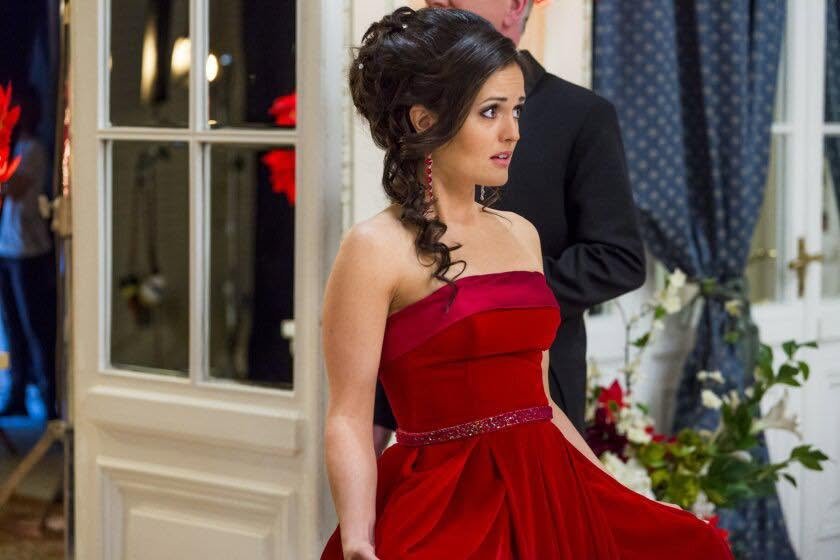
The scene represented here captures that quality particularly well. A glamorous Christmas setting can suggest transformation without requiring a character to become someone else. Allie’s journey is not really about becoming royal. It is about discovering that she can be valued for the qualities she already possessed—kindness, courage, loyalty, and the willingness to care for people who need her.
That may be why the movie’s fairytale elements never completely overwhelm its emotional core.
At its heart, Crown for Christmas offers a simple promise: a difficult chapter does not have to be the end of your story. Losing a job can lead somewhere unexpected. A grieving family can begin to heal. A child who feels lost can find someone who understands her. And a person who never imagined belonging in a palace can discover that home is less about where you come from and more about where your heart finally feels understood.
That is the kind of Christmas message that does not expire.
And perhaps that is why viewers can look at a moment like this one, years later, and still feel that little spark of fairytale magic. The gown, the lights, the royal surroundings, and the romance create the spectacle—but hope is what makes the scene memorable.
For fans who return to Crown for Christmas every holiday season, that is more than enough reason to press play again.
