Part Three: Why It Keeps Finding Its Way Back Into Christmas Traditions
There is a reason some Christmas movies become annual traditions while others are watched once and forgotten. It isn’t always about having the most original premise or the biggest cast. Sometimes it comes down to how a movie makes you feel when the credits begin.
A Biltmore Christmas leaves viewers with the sensation that they have spent time somewhere beautiful.
That feeling begins with Biltmore itself. The estate’s history and architecture give the film an elegance that is difficult to manufacture. According to Biltmore’s own behind-the-scenes account, the property had a long history as a filming location, but A Biltmore Christmas marked the first time Biltmore House played such a central role in the storyline.
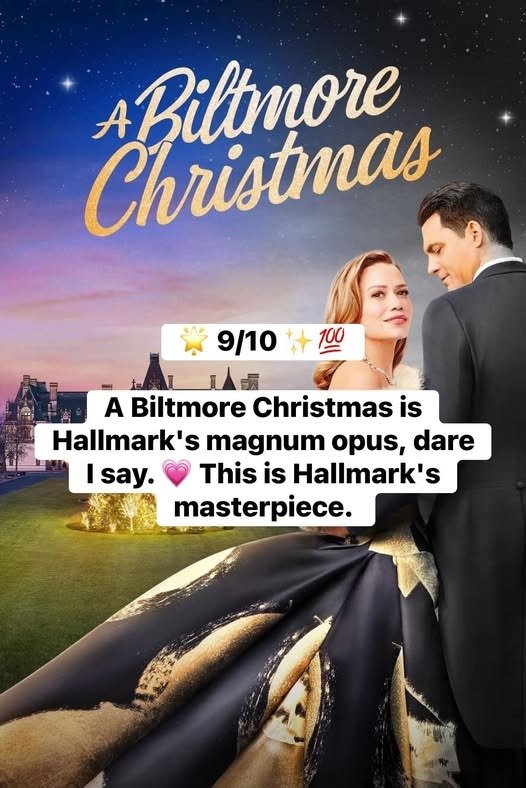
The production also paid unusual attention to the details surrounding the 1940s setting. Bethany Joy Lenz wore 11 costumes in the film, including four specifically designed as 1940s-era looks. Her finale ballgown incorporated fabric sourced from an original Carolina Herrera design, while her necklace was an original 1930s Czech crystal from the costume designer’s collection.
Those touches help explain why the movie looks so memorable. It isn’t simply decorated for Christmas. It is dressed for a particular time, a particular kind of romance, and a particular fantasy of the holiday season.
And then there is the emotional nostalgia.
For many viewers, Christmas movies are about repetition in the best possible way. We watch them because we already know the comfort they offer. We know the lights will sparkle, the music will swell, the romance will eventually find its way home, and hope will have the final word.
But A Biltmore Christmas adds another layer: nostalgia for movies themselves.
It celebrates the magic of old films, the romance of classic Hollywood, and the idea that stories can survive across generations. Lucy is connected to a fictional movie from decades earlier, while modern viewers are watching her experience that same sense of wonder. The movie essentially creates a conversation between different generations of Christmas storytelling.
That may be its secret.
It feels familiar without feeling completely predictable.
It is romantic without forgetting the characters.
It is nostalgic without becoming old-fashioned.
And it is magical without losing its emotional center.
That combination helps explain why A Biltmore Christmas has earned such enthusiastic reactions from viewers. Rotten Tomatoes’ audience page includes multiple viewers calling it a favorite Christmas film, while critics praised its performances, banter, production design, nostalgia, and unusual combination of time travel and holiday romance.
Is it everyone’s personal number one? Of course not. Christmas movies are deeply personal, and every Hallmark fan has a different comfort movie that feels like home.
But that doesn’t make the enthusiasm for A Biltmore Christmas difficult to understand.
This is the kind of film that feels carefully made for the viewer who wants more than a simple holiday romance. It offers a gorgeous location, charming performances, a little fantasy, a little old-Hollywood glamour, and a reminder that sometimes the stories we think we already know can still surprise us.
And perhaps that is why it has such lasting appeal.
Christmas is, after all, a season built around returning to things we love. We revisit traditions, songs, decorations, familiar faces, and favorite movies. The best holiday films become part of that ritual because they don’t merely tell us that everything will be okay. They remind us why believing in beautiful endings can still matter.
A Biltmore Christmas understands that perfectly.
It takes the classic Hallmark ingredients and gives them an elegant setting, a clever time-travel twist, two charismatic leads, and a generous dose of old-fashioned movie magic. The result isn’t just another Christmas romance. It is a love letter to the feeling of falling in love with a story—and then wanting to return to it every holiday season.
