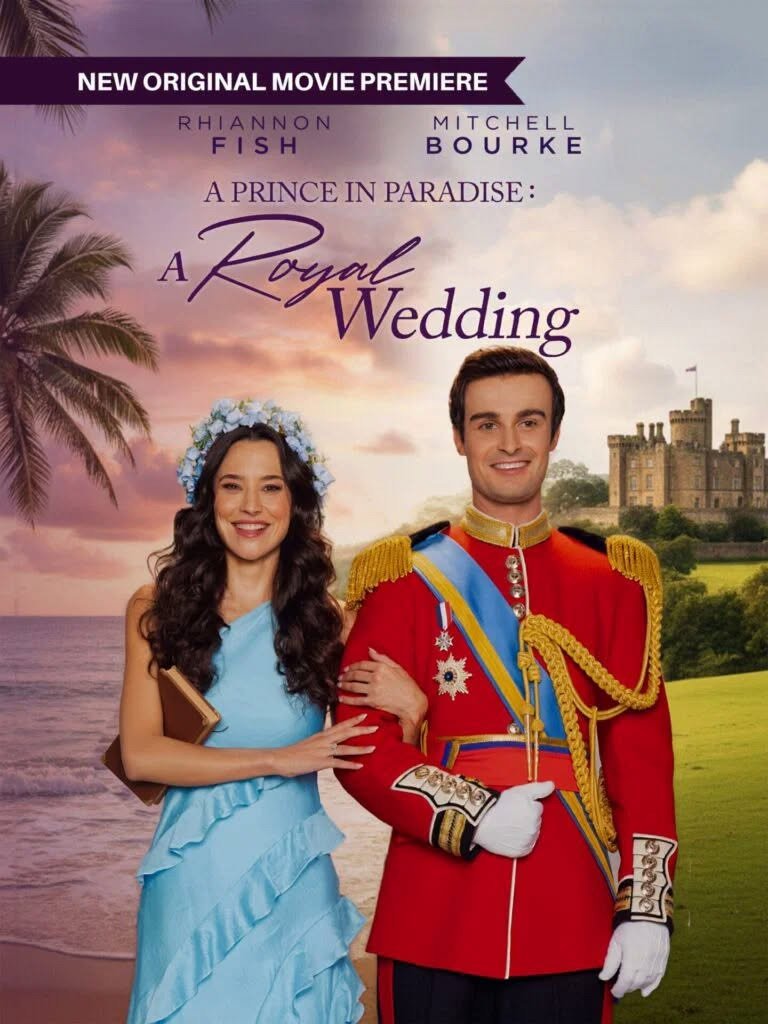
Part One: A Love Story That Has Grown Beyond the Fairy Tale
There is something wonderfully familiar about a royal romance: the grand settings, the impossible expectations, the elegant costumes and, at the center of it all, two people simply trying to choose each other. A Prince in Paradise: A Royal Wedding understands that appeal, but what makes this latest chapter especially inviting is that the fairy-tale dream is no longer just beginning. Olivia and Prince Alexander have already found one another. Now they have to discover whether their love can survive everything that comes with becoming part of a royal family.
The new film brings Rhiannon Fish and Mitchell Bourke back as Olivia and Alexander, continuing a relationship that began with A Prince in Paradise: Royal in Paradise and continued with A Prince in Paradise: A Christmas Castle Proposal. The third installment centers on their approaching wedding, but the story introduces a much more serious obstacle: an ancient law is invoked to challenge their union. Olivia, a romance writer and a commoner, finds herself drawn into a mystery involving a hidden diary and a long-buried piece of history that could affect their future.
That setup gives the romance an emotional dimension beyond the usual wedding anticipation. A wedding is supposed to represent certainty. It is the moment when two people publicly promise that they are ready to build a life together. Here, however, Olivia and Alexander are forced to question what happens when tradition, status and powerful people attempt to determine whether that future is possible.
Olivia’s position is particularly compelling because she is not simply being swept into a royal fantasy. She has her own identity, her own career and her own understanding of love. That makes the conflict feel less like a question of whether a commoner can become a princess and more like a question of whether love can remain authentic when the world around it becomes complicated.
The film also benefits from the natural warmth of Fish and Bourke as returning leads. After three movies together, the relationship between their characters has room to feel established rather than rushed. Their connection is not dependent solely on the excitement of a first meeting. Instead, the appeal comes from watching two people who already know one another face the next stage of their relationship.
That distinction matters. The most satisfying romantic stories are not always about finding love. Sometimes they are about protecting it.
